How AI Agents Are Changing the Way People Interact, Decide, and Buy

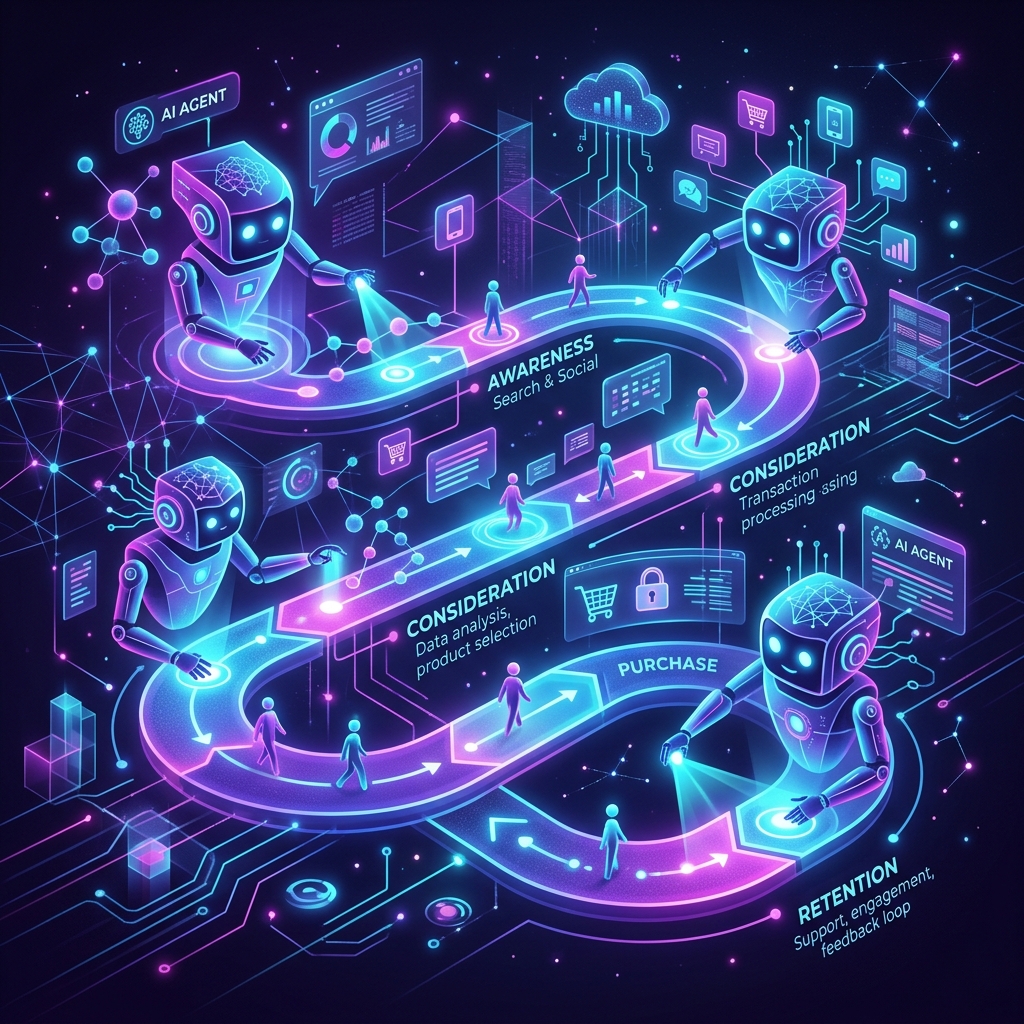
The Shift from Active Search to Passive Delivery
For the past twenty years, the customer journey was essentially a pull mechanism. If a consumer wanted a product, they searched for it. They typed queries into Google, browsed through Amazon, read reviews on Reddit, and eventually made a decision. This required active effort.
With the rise of AI agents, this dynamic is fundamentally flipping. We are moving from a world where humans search for products to a world where AI agents curate and present solutions before the human even realizes they need to search. The customer journey is becoming a push mechanism driven by hyper-personalized, context-aware AI.
How AI Agents Alter the Decision-Making Funnel
Traditionally, the marketing funnel looked like this: Awareness → Consideration → Conversion → Loyalty.
AI agents are compressing this funnel. Let's look at how:
- Awareness: Agents already know user preferences, previous purchases, and context (like upcoming calendar events or current location). Awareness is no longer about mass advertising, but about an agent saying, "I noticed your flight is tomorrow, and the weather at your destination just dropped. Should I order a jacket?"
- Consideration: The agent handles the heavy lifting of comparison shopping. It analyzes thousands of reviews, cross-references specs, and filters out the noise. It doesn't present ten options; it presents the best three, optimized for the user's specific priorities (e.g., price vs. shipping speed).
- Conversion: The checkout process is completely abstracted. The user simply says "Yes," and the agent handles payment and shipping via pre-authorized credentials.
What This Means for Brands
If AI agents are making decisions on behalf of consumers, how do brands adapt?
1. Marketing to Machines
SEO (Search Engine Optimization) is evolving into AIO (Artificial Intelligence Optimization). It's no longer just about ranking on page one of Google for human eyes. It's about ensuring your product data is structured, factual, and easily ingestible by LLMs (Large Language Models) and autonomous agents. If an AI agent can't parse your product specs definitively, it won't recommend you.
2. The Premium on Authenticity
Because agents are incredibly good at filtering out marketing fluff and spotting fake reviews, true quality and authentic customer sentiment become paramount. Agents analyze sentiment across the entire web. You can't hack an AI agent with keyword stuffing; you have to have a genuinely good product.
3. Zero-Click Commerce
Brands need to prepare for "zero-click" transactions, where the purchase happens without the user ever visiting the brand's website. This requires robust APIs, excellent supply chain integration, and a shift in how success is measured (moving away from purely web traffic metrics to API transaction volume).
The New Customer Journey
The customer journey of the future isn't a straight line; it's a constant, ambient conversation between the user and their AI agent. The brands that win will be the ones that seamlessly integrate into that conversation, providing structured data and undeniable value to the algorithmic gatekeepers.
Are you ready for your customers to stop shopping for themselves?
Discussion