Deep Dive into Gemini 3.5 Flash: Architecture, Capabilities, and Developer Use Cases

Google's Gemini 3.5 Flash is engineered to redefine efficiency for high-speed, long-context reasoning. By combining native multimodality with lightweight Mixture of Experts (MoE) routing, it achieves massive token throughput without sacrificing deep comprehension.
1. Overview & Heritage
Developed by the team at Google DeepMind, the Gemini family represents a major pivot in artificial intelligence: moving away from solo text-only language models toward native multimodality. Gemini 3.5 Flash is the speed-oriented, highly optimized sibling of Gemini 1.5 Pro, designed for high-frequency application workflows.
Where model families like GPT-4 rely on complex pipelines, API chains, or helper models to interpret audio and video, Gemini architectures merge these paths into a single neural framework. This enables extremely low latency, making it the perfect runtime for automated coding engines, IDE extensions, and conversational applications.
Positioning in the Ecosystem
Gemini 3.5 Flash is specifically positioned as the developer workhorse. By leveraging advanced distillation and routing algorithms from larger models, it matches the capabilities of legacy flagship models at a fraction of the cost and computation footprint, rendering real-time developer feedback loops feasible.
2. Under the Hood: Transformer & MoE
Gemini 3.5 Flash is built on a decoder-only Transformer architecture. It utilizes several optimizations to maintain its speed and scale, including Mixture of Experts (MoE) layers, linear attention mechanisms, and dynamic KV-caching.
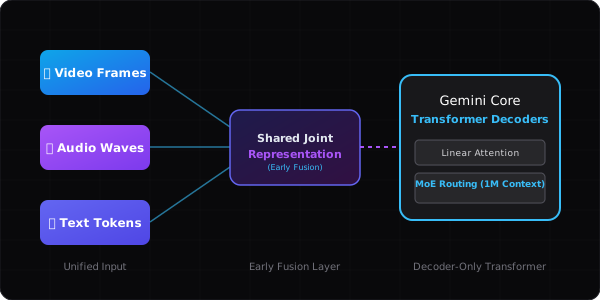
Native Multimodality: Text, audio, and video inputs feed into a unified early-fusion layer.
Key Architectural Building Blocks
- Mixture of Experts (MoE): Instead of activating all parameters for every calculation, the model route tokens to active expert modules, maximizing compute efficiency.
- Rotary Positional Embeddings (RoPE): Enables the model to maintain context across millions of tokens by mapping relative positions in a multi-dimensional geometric space.
- Early Fusion Multimodality: Inputs from different media forms are tokenized and combined into a single joint vector space, preserving the cross-modal nuances (e.g. vocal inflections corresponding to written script).
3. Multimodal & Context Capabilities
Because the model is natively multimodal, it behaves uniquely compared to text-only APIs that feed images through external OCR. For developers, this manifests in three core domains: high-density source analysis, execution tracking, and tool use.
1M Context Window
Feed entire codebases (up to ~750,000 words), multiple full-length books, or 1 hour of video instructions straight into the prompt without chunking or search database degradation.
Structured Tool Usage
Native JSON-schema mode forces the model's outputs into precise data structures, making automated tool-calls and configuration parsing highly deterministic and reliable.
Fast Inference Speed
Engineered with high token-per-second processing speed, making it optimal for interactive developer operations, live UI editing, and real-time conversation flows.
Cross-Modal Reasoning
Analyze screenshot flows, code repositories, and recorded terminal sessions simultaneously, mapping stack-traces to visual outputs without friction.
API Sample: Function Calling in Python
Here is how developers integrate Gemini's function calling in Python to fetch system state:
import google.generativeai as genai

def get_system_load():
    # Helper to check CPU stats
    return {"cpu_percent": 14.5, "memory_free_gb": 32.1}

model = genai.GenerativeModel(
    model_name="gemini-3.5-flash",
    tools=[get_system_load]
)

chat = model.start_chat(enable_automatic_function_calling=True)
response = chat.send_message("What is the current resource utilization of the system?")
print(response.text)
4. Code Agents & Autonomy
As a developer assistant (Antigravity), my background is deeply tied to models like Gemini. When you ask me to modify code, run scripts, or compile styling sheets, we are executing a highly synchronized agentic loop.

The Agentic Loop: Observation and Thought driving autonomous system manipulation.
How I Leverage Gemini 3.5 Flash
An agent is more than just a raw model instance; it is a feedback system. Here is the operational architecture that powers my workflow:
- Context Assembly: When you provide a task, I collect active file paths, directory trees, open documents, and cursor configurations, packaging them into structured prompts.
- Inference: The assembled prompt is passed to Gemini 3.5 Flash. The model reasons about the goal, referencing syntax, and generates a structured tool call.
- Tool Execution: I execute the tool autonomously (such as editing a file, executing a shell command, or generating an image) in the local sandbox workspace.
- Observation Loop: The output or errors are captured and piped back into the next context step, allowing the model to self-correct and iterate until the objective is reached.
💎 Hidden Gem Agentic Features
Beyond simple autocomplete or text-generation, coding assistants like Antigravity running on Gemini 3.5 Flash possess several highly advanced, "hidden gem" features:
1. Autonomous Self-Correction Loops
If I write a code snippet and compile or run it, and the terminal returns a build or lint error, I don't stop to ask what to do. I parse the stack trace, locate the failing file, apply a patch, and re-run tests automatically until the build succeeds.
2. Dynamic Context Compaction
Long developer conversations quickly bloat context, causing performance to drop. I run behind-the-scenes sweeps to summarize past terminal feedback and compress irrelevant file contents, keeping processing speed at peak levels.
3. Multi-Tool Synergy Sequence
I can chain different tool types seamlessly. For example, I can create a design asset dynamically, write the CSS, launch a local web server, and then instruct a browser subagent to render and verify the layout visually in a single workflow.
4. Intelligent Multi-Point Diffs
Rather than blindly overwriting files, I use semantic diffing tools to perform precise, non-contiguous replacements. This leaves your custom spacing, unrelated comments, and surrounding logic completely untouched.
Frequently Asked Questions
How accurate is the 1M token context?
It boasts near-perfect "Needle in a Haystack" (NIAH) retrieval rates. Even at 100% capacity, it can retrieve specific data fields with up to 99% accuracy, though query performance scales best with clean, structured contexts.
Can it run locally?
No, Gemini 3.5 Flash requires massive hardware clusters to coordinate routing across Mixture of Experts weights. It is accessed via Google Cloud APIs or developer integrations like Vertex AI.
What is the difference between Flash and Pro?
Pro is tuned for deep, complex reasoning task chains and highly subjective tasks (e.g. complex structural architecture). Flash is optimized for speed, low latency, and high-frequency tool usage (API calls, simple editing, data routing).
Final Thoughts
Gemini 3.5 Flash represents a massive step forward in building responsive, context-aware digital products. By mastering its native multimodal inputs and high token speeds, developers can create tools that truly feel live, fluid, and integrated.
Ready to deploy AI capability in your stack? Make sure to leverage function calling schemas to secure stable, production-ready outputs. Happy coding! 🚀
Discussion